I Had the Dream, and Now I Get to Live It – Interview with Falk Maria Schlegel (Powerwolf)
Powerwolf headlined Wacken this year, 2026. I stood in the crowd, thrilled, swept up by the music, the mesmerizing show, and the band’s interaction with the audience. When they asked, “Which of you has never seen us live before?” I had to raise my hand, unfortunately. In the Middle East, I hadn’t had the chance yet. And in my mind, I could already picture that magnificent show taking place in front of the pyramids.
One thing puzzled me, though. I knew Powerwolf was a German band, yet Attila, the frontman, kept thanking the crowd with a “Vielen Dankeschön” that sounded almost Eastern European. I was curious enough to look into it, and learned it was his trademark. While researching, I also came across the band’s current tour dates and happily discovered: one weekend after Wacken, on August 8th, Powerwolf was set to play Hamburg’s Elbriot Festival. In that moment, it was clear to me – I wanted an interview with them.
Before an interview like this can happen, several people are involved: promoter Hamburg Concerts, the band’s management, and the tour manager all had to sort out accreditation, interview questions, and a time slot. On the day of the festival itself, everything went smoothly. I was picked up at the entrance by Kevin Junker, the press officer, and taken to the backstage area. The festival took place at Hamburg’s Großmarkt and felt like a mini Wacken – the same kind of crowd, and even Mambo Kurt provided entertainment in the beer garden during the stage changeovers. We were a bit early. Orden Ogan was still playing on the nearby stage, and it would have been too loud for an interview. So I waited outside the tour manager’s container and watched the goings-on in the backstage area. Under a sun umbrella at the beer tables sat Dom R. Crey, who is standing in for guitarist Matthew Greywolf on this Powerwolf tour. The artist area is generally where performers go to unwind, so I held back my excitement and didn’t approach him. Members of the band Savatage, whose backstage area was next to the tour management container, walked past me and greeted me warmly. Those are the cool moments as a journalist. Once things quieted down on stage, the tour manager brought Falk Maria Schlegel over for the interview. My first impression – “wow, he’s nice” – was confirmed as the interview went on. As I opened my laptop, I introduced myself briefly to break the ice; after all, two strangers meet in an interview like this. But within a few minutes, the interview turned into a friendly, informative conversation. First, I wanted to know more from Falk about the band’s current stage show.
Monika: So, I saw you at Wacken on that huge stage with the big production. The stage here is a bit smaller than at Wacken. But you also play big arenas and all kinds of festivals. Do you still play small club shows? Is that even still possible?
Falk: Not at the moment, I have to say clearly. We do try to present our production in the best possible way. But of course, even at festivals there are already limitations, like here at Elbriot, simply because the stage depth or height isn’t always there. Playing small clubs is still something we say we’d love to do again. Because of course big productions – that always takes a lot of lead time too. And it’s all somehow very – how should I put it – very technical as well, in that sense. Sometimes a small stage or a smaller production, where it’s just very classic, is a really honest kind of show. And we definitely keep that in the back of our minds, thinking: hey, let’s play some small shows and just call it a club tour. But not yet. Right now we still want to try to fill the big arenas.
Monika: But say I’m a promoter. What do I need to bring besides money? Do you come with everything, pyro and all the technical equipment included – or what does a promoter actually need to provide in order to book Powerwolf?
Falk: There are always two approaches, really. If you’re talking about our own tour, or our own arena tour, we actually bring everything ourselves – pyro, all the departments, lighting setups too. That means all that’s there to start with is the bare stage. If you come to a festival, then it’s more that our production makes requirements of the festival production, for lighting and sound, and those are often met. But if you’re not the headliner, then it’s take it or leave it. If you’re not the headliner and you say, well, I’d really like this or that too, you often don’t get it anyway. But that’s not really a problem either. Because I like to emphasize this about Powerwolf: we come from small clubs, we grew up from the bottom, and we already tried back then to entertain people without any fuss and without a big production. And as a band, you always had to make that work. If the production is the only star, I actually find that difficult. Then I sometimes find the band itself boring. Since I was also a guest at Rock am Ring this year, I saw a number of big bands and thought a lot of it was musically good. But there was one band that hid itself away behind the production and the screen programming. You can like that if you see it as artistic. I’m wired a bit differently. At the end of the day, I want to see the band. Not just the lighting rig. I don’t want to see a silhouette either – that can happen once in a while. But at the end of the day, I want to see the singer I actually think is great, and I want to feel close to that artist. That’s very important to me. That’s also Powerwolf’s approach. I want to be close to the audience. Which means our lighting design has a clear instruction: faces lit. When it comes up that blasting the big lights from the front loses some of the backdrop, I say: doesn’t matter, people need to see the band. And I find that extremely important.
Monika: That’s something I noticed positively too.
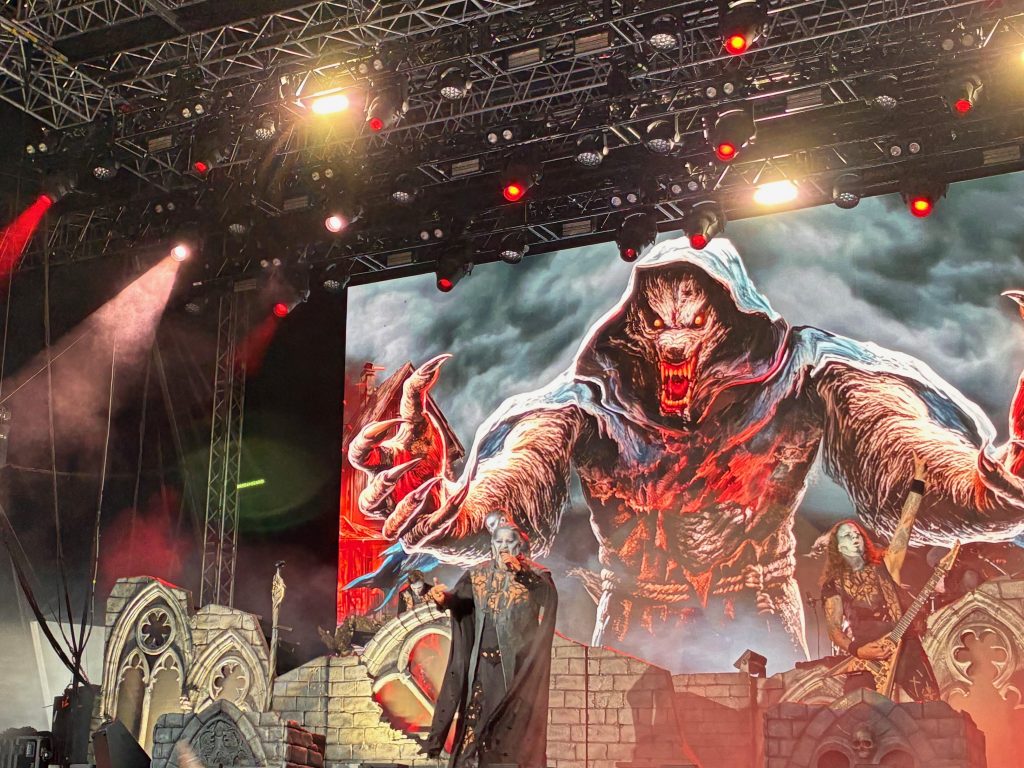
Photo by: Monika Bremer
Falk: It’s really also the dialogue with the audience. All of that has to fit the concept at the end of the day. Even when the guy up there cracks a joke where you sometimes think: did he really just say that? It somehow makes it likeable and approachable too. And I think that’s something I particularly like. It’s also something I grew up with. I always found it exciting when a singer made an announcement that was maybe a little different, or even had a slip of the tongue in it, that always showed a bit of closeness. Where I thought: oh, that’s fun. I don’t just want to hear one song after another like the album. And that’s why I sometimes find announcements unbearably boring when it’s just, “the next song is from the album XY.” Please, no.
Monika: Does it make a difference for you whether you’re playing your own tour, where people come just for you and you might have one or two support bands, or whether you’re at a festival? Is that a difference?
Falk: It’s definitely a difference. How should I describe it? At a festival like Wacken, Summer Breeze, and so on, every band gives it everything. Everyone wants to bring the house down, everyone wants to go home and say: okay, now the headliner has a hard act to follow. I mean, we always did the same thing. You want to present yourselves in a way that lets you say afterward: huh, we really rocked this place.
Monika: Isn’t that true after every show? Is that only the case after festivals?
Falk: Yes, it’s like this – you have that brief moment where you might want to seize the chance as a band. And of course you also realize, okay, now you have to kick it up a notch. Now you have to push harder, now you have to pull the crowd in even more. Now you might also have to win over people who aren’t necessarily on your side. Whereas at your own show, as a rule, the people who come already love you. But it’s also a fallacy to think that makes your own show easier. Because – how should I put it? Fans of a band, fans of Powerwolf, they want to have a good time too. Even with your own fans, you still have to go out there as if it were basically a show where you’re playing for the very first time. So you have to approach it with the right mindset, and of course at Wacken Open Air, you’re playing Saturday night, a whole week has already gone by. People have already stood around a lot, spent a lot of time, partied a lot, had a lot to drink. And then the question is already: can you still top that? And even at your own show, you can’t just assume it’ll happen on its own. You still have to deliver in a way that makes people say: hey, that was really good again.
Monika: Are your own fans maybe even more critical than people who don’t know you?
Falk: I really can’t answer that in general terms. I just think the highest standard has to be that it’s not a given, that nothing runs on autopilot, and that just because a lot of people here are wearing Powerwolf shirts doesn’t mean the show works automatically. You have to stay authentic. So if I put on a boring performance on stage, the audience notices. I also feel that when I go to concerts myself, I need a band that radiates something. That doesn’t always have to be as theatrical as Powerwolf. But it has to mean: hey, I’m here in this moment, I’m giving it everything. If I get the feeling that a band just wants to run through their set, I get bored extremely fast. I was recently at Sepultura’s farewell tour in Saarbrücken. They come out on stage – they’ve been doing this for 40 years now, I think. And you think to yourself, wow, it’s like a chainsaw ripping straight through the building, and bam. That completely blew me away. Nobody’s waving a flag, there’s no clap-along part, but it’s just this bam – we’re here. I find that absolutely fascinating.
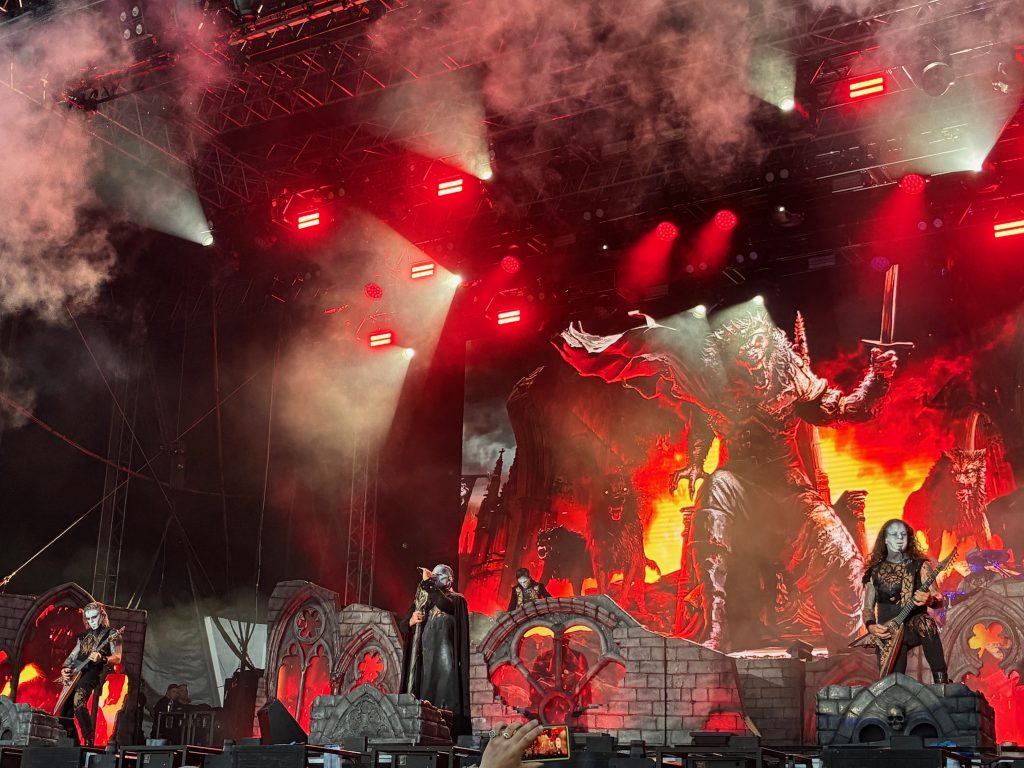
Photo by: Monika Bremer
As it turned out, watching Powerwolf’s show that evening didn’t feel like a repeat of the Wacken performance at all. The stage show was somewhat shorter than at Wacken, admittedly – apparently due to Hamburg’s curfew. For instance, the band skipped putting Falk on the stake this time, a moment at Wacken where I remember thinking, “God, I hope they’re wearing fireproof clothing.” There was still plenty of room on stage, though, for Falk’s fire organ and Attila’s fire weapons. And while the interaction with the crowd resembled what I’d seen at Wacken, it was nonetheless tailored to the Hamburg audience. During the sing-alongs, for example, the security staff in Hamburg turned out to be considerably more vocal than the photographers had been at Wacken – at least wherever I happened to be standing. Watching the visuals on the screens, I found myself thinking back to my conversation with Falk about international success. Would it even be possible to show werewolves and scantily clad women on giant screens in the Middle East?
Monika: The US and Europe, that’s all fairly Western. Now you’re going to Japan for the first time, and you basically perform a kind of metal mass, with a religious theme, or an anti-religious one, depending on how you want to look at it. Do you think you’ll be understood there, even though people there aren’t really Christian, but predominantly Shinto and Buddhist? Do you think it’ll work?
Falk: Yes, I think people there will probably see it less through that religious lens. We’re not really religious ourselves in the classic religious sense, either – it’s more liturgy, and we want to turn that into something a little more positive. Catholicism, after all, is often loaded with negativity and fear. And I think if you just see it purely as a show, then it works simply through the music. It’s an interesting point, actually, that religion isn’t so present there in that sense. But I think at the end of the day, our credo is: Metal is Religion. That’s universal. There too, our aim is to offer a production, a show, that at least in its approach comes close to our European show.
Monika: Where will you likely be playing in Tokyo, then?
Falk: An arena. It’s a venue for around 10,000 people. It’s already selling pretty well too. So it’s basically a kind of festival in itself. What matters is that we have a stage size that matches the whole thing. And then we’ll just see what happens. I don’t know for sure, but honestly, I do think it’ll work out pretty well.
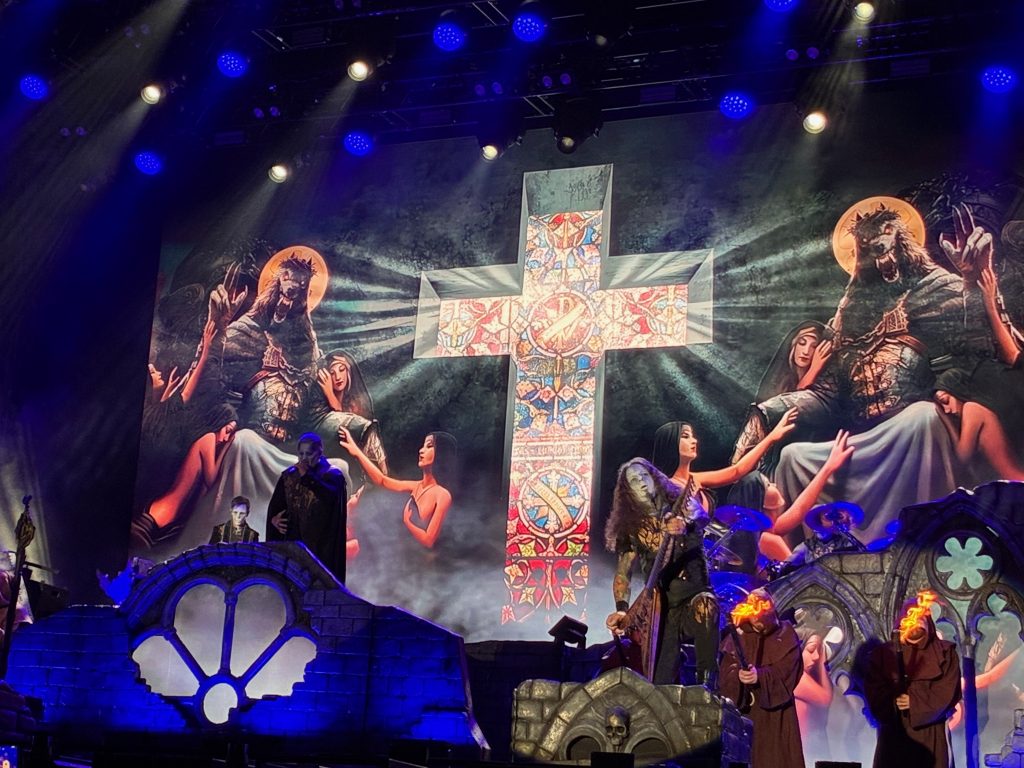
Photo by: Monika Bremer
Monika: Is the Middle East a region where you’re aware you have fans across different countries, and are you in touch with those fans?
Falk: We are aware of it, yes, but as far as actual contacts to organize a concert go, those pop up now and then. In principle we’re open to it, but it’s not like we’ve ever had a real offer on the table where we had to say yes or no – it’s more that something pops up occasionally, I pass it along, and then nothing comes of it. Maybe people don’t dare to reach out – so maybe this can also serve as a bit of a call-out, if anyone reads this: get in touch with us.
Monika: Imagine I gave you plane tickets and a stage – where in the world would you fly to?
Falk: If you ask me, honestly, pretty much anywhere.
Monika: Yes, but what’s your dream stage? Where have you never been, where you’d say, if only I could play there?
Falk: I’ve actually never been to Tel Aviv, never been to Israel. I always wanted to travel there at some point. It was a big dream of mine. There was actually an offer once, for example. It fell through at the time, I honestly couldn’t tell you exactly why anymore. And honestly, quite openly, I would have loved to do it. I think it was two shows, Tel Aviv and Jerusalem, and I would have loved to do them. But I also don’t want to hide the fact that I wasn’t entirely sure whether our image and our creed might come across as offensive there.
Monika: How is what you convey content-wise interpreted in different regions and cultural contexts?
Falk: That question of context, that’s actually made me think. We had this exact discussion in Russia too. Well, there are fanatical Christians out there who really don’t like us at all. You find them everywhere. The US has them too – people standing right out front with a cross and so on. And then I talked to the Russian promoter, and he said, actually in that case it’s not necessarily the fanatical Christian, it’s more some government people who are against it. And in general, I find it a shame that no matter which country you’re playing in, you have to think about this at all. At the end of the day, this is art. It’s not like we’re making some statement like, “come to Catholicism” or whatever – we say, quite tongue-in-cheek, that we want to convert people to metal. That’s basically it. I have to bring up Russia again. In Russia, for example, I once kissed Attila on stage – I just felt like it, so we did it. It’s still online in Moscow to this day. Rammstein had done the same thing. But it could cause us problems.
I don’t know what’s real and what’s just a stereotype there, and at the same time I think: hey everyone, can’t we just – I know it’s naive – but can’t we just, at least in the context of music, love each other a little bit? Afterward we can go back to debating controversial things, discussing whatever needs discussing, but here, in this setting of music and art, let’s just have a good time. That would be my wish. But sadly, the world isn’t like that. But we’ve actually never really faced any hostility either. And we’re often out and about in monasteries, we record in old churches, we do photoshoots there. And everyone who comes into contact with us realizes that none of it is meant to be disparaging, shameful, or offensive. That’s very important.
But of course I could understand it if someone said, I don’t want a band in face paint in my building – I don’t know how I’d decide if I were the landlord. You know what I mean?
And yes – I knew exactly what he meant. I know musicians from the Middle East who still remember times when metal concerts were difficult to put on. In a region that has set itself the goal of stability and is repeatedly challenged by political events, unrest caused by misunderstood concerts is something that can hardly be afforded. Thankfully, the situation has improved considerably in recent years, in favor of musicians and the metal scene. Big bands like Metallica, who headlined the Soundstorm Festival in Riyadh in 2023, likely also contribute positively to that. Wacken’s up-and-coming band competition, the Metal Battle, is also internationally set up and tries to put the music front and center – independent of political circumstances. The Metal Battle gives young bands a chance to advance their careers. If music can cross borders, and the Metal Battle makes bands visible internationally, the question arises of how a German band like Powerwolf itself became an international headliner.
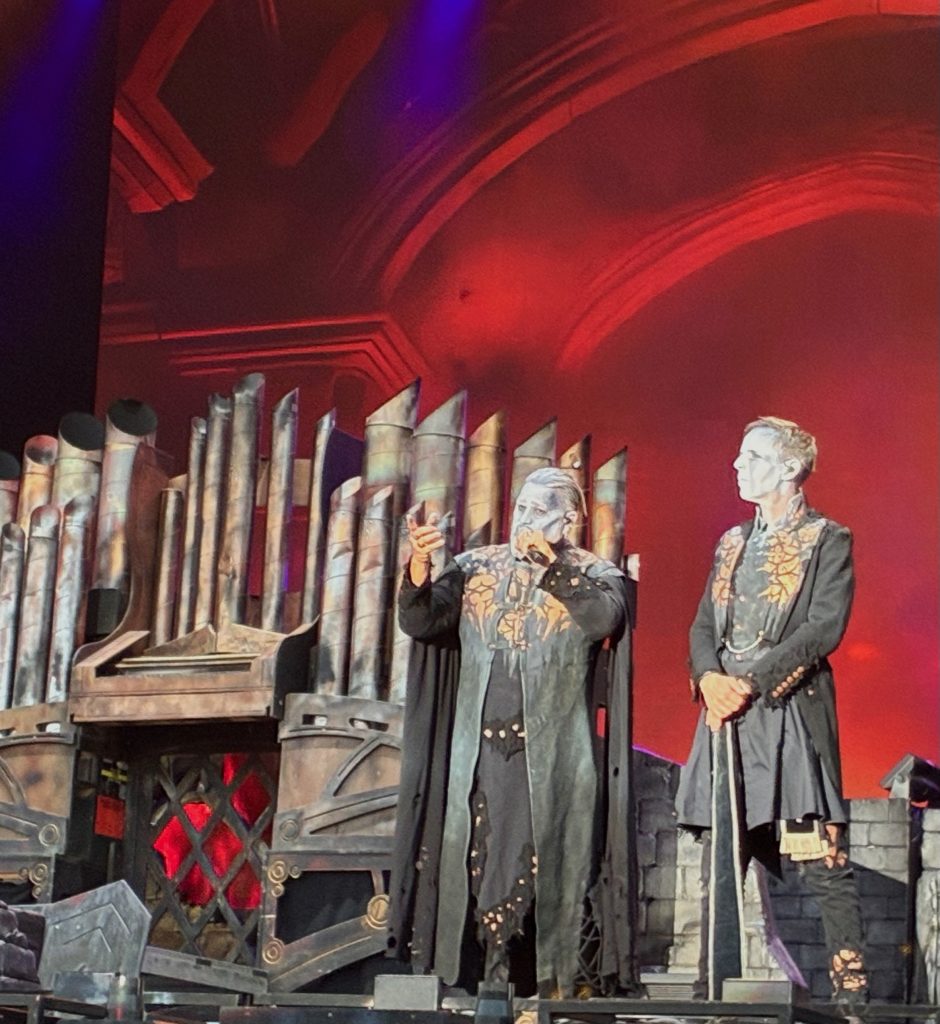
Photo by: Monika Bremer
Monika: Is there anything where you think today, I could never have imagined at the start of the band that it would turn out this way?
Falk: I don’t think I could ever have imagined that we’d headline Wacken. As a young kid, I desperately wanted to get on a stage. I always pictured it, and I also always pictured myself driving the truck.
Monika: Have you?
Falk: I got to drive our 40-ton truck once, across the parking lot. So that’s checked off. But it was always like this: I saw Iron Maiden, back in ’92 somewhere, and thought, wow, I want to stand on a stage, play in front of that many people. I can’t say that after that I did everything to make it happen. It was just a dream. And the band was actually always built like this: we always give our best, then we see what happens, then we give our best again. And we’ve done that for 20 years now. Then things developed from there.
But we didn’t stand there in 2004 and say, okay, in 20 years we want to be Wacken headliners, and then draw up a blueprint for how to get there. Because at the end of the day, it’s not the band that decides that, it’s the fans.
And we simply had some lucky moments. We had a tour with Sabaton back then, and there was this new wave in power metal that we helped create a little bit too. It was something new in the scene. Sabaton paved a new path. A fan culture developed around that, and a younger generation grew into it. That was really important.
But also this constancy of staying together as a band – aside from one lineup change, we’re still the same band. And we simply never stopped giving it everything. So we never said, oh, I just bought a house, now I need to plaster the walls, I can’t play this summer. Instead it was more like, there’s a tour coming up – yeah, let’s do it. Can you make it? Yes. Can you fill in as support? Yes. We still had our day jobs at times, we’d drive back from a show on Sunday and be standing at work on Monday. So it was this kind of drive, this determination to make use of the opportunities that came our way, every single year. And looking back, the way things have developed is wonderful, but it’s not something you can take for granted. It means you still have to keep doing good work, still enjoy the whole thing, so it doesn’t become routine – otherwise you don’t even know what happens next. But that’s the thing, to come back to your question: I had the dream, and now I get to live it.
Monika: Is that determination what you’d advise young musicians to have?
Falk: Definitely. I actually get the sense, with young musicians, or with young people in general, that they’re very driven. They really want to make things happen. They want to move forward. They also want to make full use of the media available to them today. But I think three or four years ago it was still a bit different, when I still had the feeling that nothing moves forward here if you don’t have a record label. I think now there’s a generation that just says: I don’t need anyone, I can do all of this myself. I find that pretty impressive. I think what everyone’s trying to do a bit, of course, is search for that unique thing. But you don’t have to do that just to be successful – instead you have to have something that defines your art, and then maybe the audience will think it’s great. But if you start trying to figure out what might be successful right now, what you should do to stand out – then I think that just leads to some lame mainstream stuff.
Monika: So authenticity is what it comes down to?
Falk: Exactly. So you have an idea, that’s your concept, whether it’s original or not is beside the point, and you pursue it consistently. And we simply wanted to do something with makeup, with our look. We powdered our faces white, with red on the face, which looked pretty ridiculous at first, but then we kept developing it further. It keeps evolving, but it’s something we genuinely wanted to do.
And as the keyboard player, I was often insulted and laughed at too. I’ve had some negative experiences. A keyboard player in a metal band, on top of that wearing makeup, standing right at the edge of the stage, trying to get the crowd going. There was real hostility at times. But I was fine with it, if anything it just spurred me on.
So, on the subject of advice: I think that determination already exists in a lot of young bands. Beyond that, it simply comes down to authenticity.
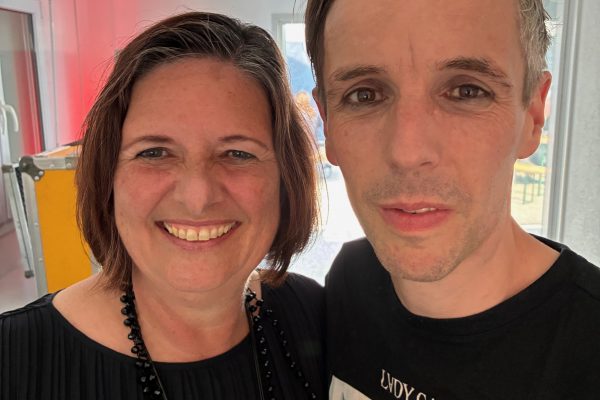
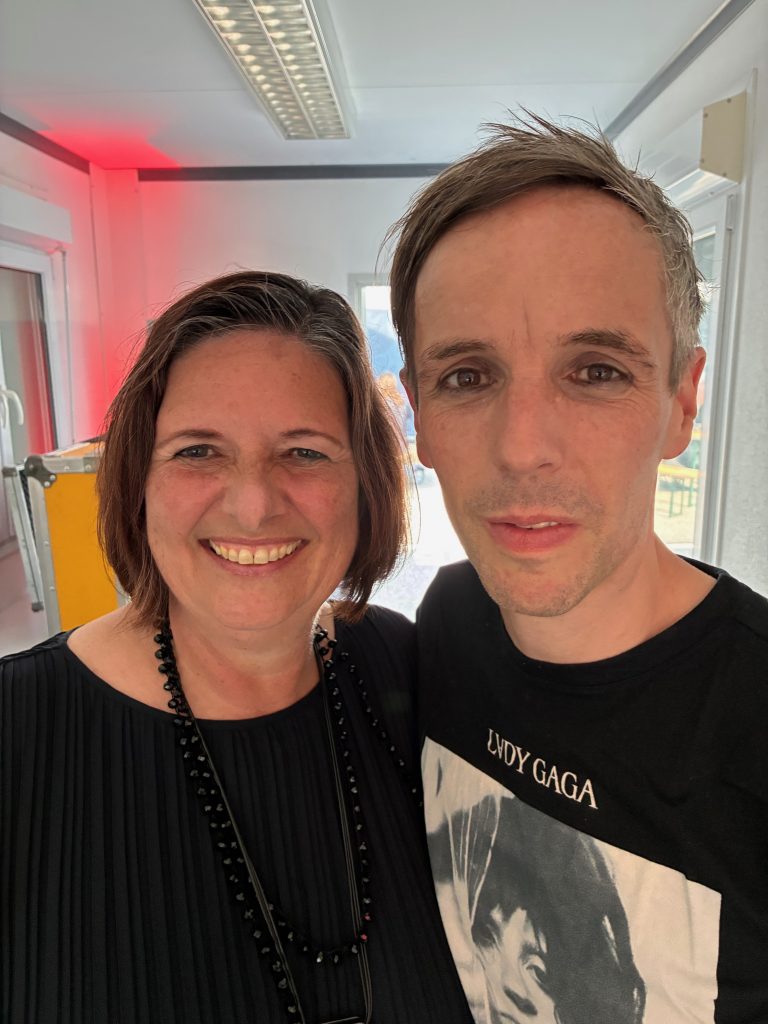
Sadly, the time with Falk flew by far too quickly, and we had to say goodbye. There was still a brief moment left for a photo together, though. During the show that followed later, I found myself watching Falk with different eyes. His words came back to me. How far can you go on stage? Where’s the line between entertainment and being ridiculous? How do we reach the audience? I thought the show was fantastic and completely authentic. I enjoyed the various jokes, sang along at the top of my lungs, and was every bit as thrilled as many others around me. Because one thing was unmistakable about Powerwolf: the sheer joy in the music, the mischief in their eyes, and the fun they had performing. I was standing fairly close to the front, and during the closing applause I made a little heart shape with my hands as a token of appreciation for what I thought was a fantastic performance. And I’d like to believe Attila saw it and was pleased. The moment the lights went out, things got hectic on stage. I stayed a little while longer and watched what felt like an entire army of stagehands storm the stage and tear down the stage elements at lightning speed. After all, everything had to be packed up quickly – the next show was already happening the very next day, at the Alcatraz Festival in Belgium. Best of luck for the rest of the tour, and Vielen Dankeschön, Powerwolf. It was an honor to be able to accompany you for a little while this summer!
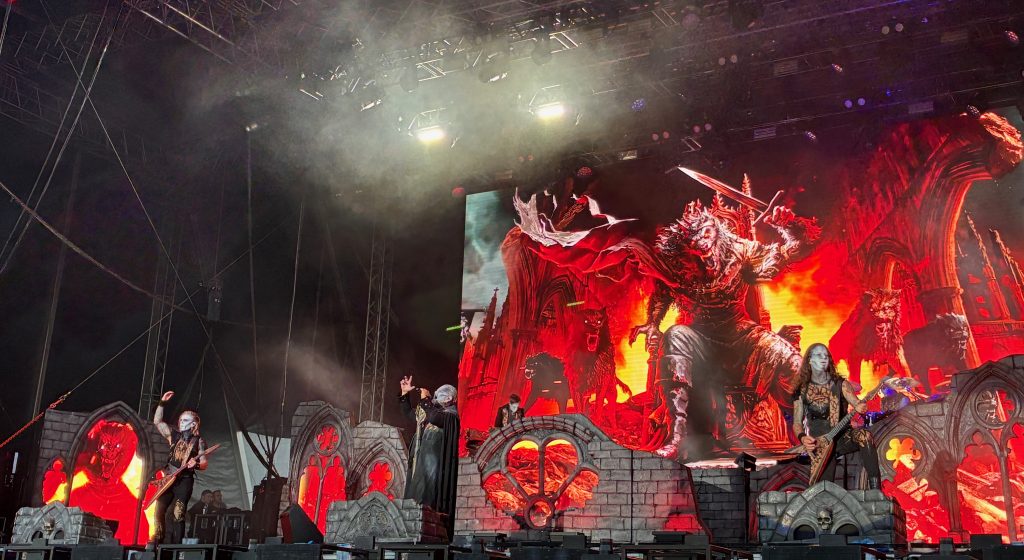
Photo by: Monika Bremer