Three Stories, One Festival – And What Remains of Wacken
Wacken – already one month ago. And this year, I heard more bands at Wacken than ever before in all the years prior. Sounds strange? But it's true. I'm Monika Bremer, a journalist. Since summer of this year, I've been writing for The Metalist – and the contact for that came about in Wacken.
Because for the past 12 years, I built up the Middle East Metal Battle for Wacken. Starting in Cairo, followed by Beirut and Dubai, all the way to Saudi Arabia and Bahrain. I was invited to sit on the jury in Israel. And had a booking error by my travel portal not denied me exit from Egypt to Tel Aviv, then what politically isn't supposed to happen would actually have happened: the promoter for the Middle East Metal Battle sitting on the jury in Israel. But that's exactly what I always wanted to achieve with the Metal Battle. As a German cultural manager, music teacher, and journalist, opening the path to Wacken for bands from the Middle East, and showing that music connects, and that encounters are possible peacefully, regardless of politics or origin. And over the past years, on the campground and backstage, people whose countries are not on good political terms with one another met each other peacefully.
A band from the Middle East has yet to reach one of the coveted top 5 spots in the final. But Wacken is about more than winning the Metal Battle. Things and times change, and after my move to Hamburg, others took over responsibility for the Middle East Metal Battle. So this year, I had time to listen to bands, go to parties, and experience Wacken differently.
Wacken means main stages and headliners. But the stories that stay with you often play out on the sidelines: on the campground, at a party, in line for the shower container. I followed three of them on site.
Given by the Flames (GBTF) – Metal Battle Winners from Japan Under High Pressure to Perform
This year, my tent was pitched next to my former promoter colleagues and their bands. Every morning, the anxious glance out of the tent – is everything dry? Quickly brush my teeth and dash under the awning of the camper van belonging to friends of the Japanese Metal Battle winning band "Given by the Flames" (Willian – vocals, band founder and leader; Diekey – guitar and vocals; Shima – guitar; Noi – drums | gothic metalcore). My job was making coffee every morning.
When the young Japanese musicians or their promoter Yutaro crawled out of their tents, an always cheerful-sounding "Ohaiooooo" – good moooorning – rang out, and everyone was happy about hot coffee. I was met with some skepticism when I suggested trying bananas or other fruit with Nutella. Hesitantly, guitarist Diekey eventually spread Nutella on the banana, and when he tried it, his whole face lit up. Communication was sometimes a bit difficult, though, because really only Willian, the band leader, spoke English.
Off stage, though, the band was noticeably active – in Wacken United and the Metal Battle Lounge, where bands, promoters, and journalists meet, but also on the campground, backstage, and at parties. That's exactly why Willian learned English in the first place as a teenager, he told me: "I wanted to be able to talk to other bands. That's why I learned English – and I'm glad I did." Whether that ultimately leads to real contacts or just festival small talk, he himself doesn't quite know: "I think a lot of people just talk and then don't stay in touch. But the people I've talked to can see that I mean it." His dream: to play in Japan someday, with exactly the people he met at Wacken. "But nothing is promised. That's the exciting part.“
Like most Metal Battle bands, Given by the Flames were at Wacken for the first time, and travel expenses were funded through crowdfunding. "We set the bar high and didn't expect we'd actually make it," Willian reported. In the end, though, more came together than expected.
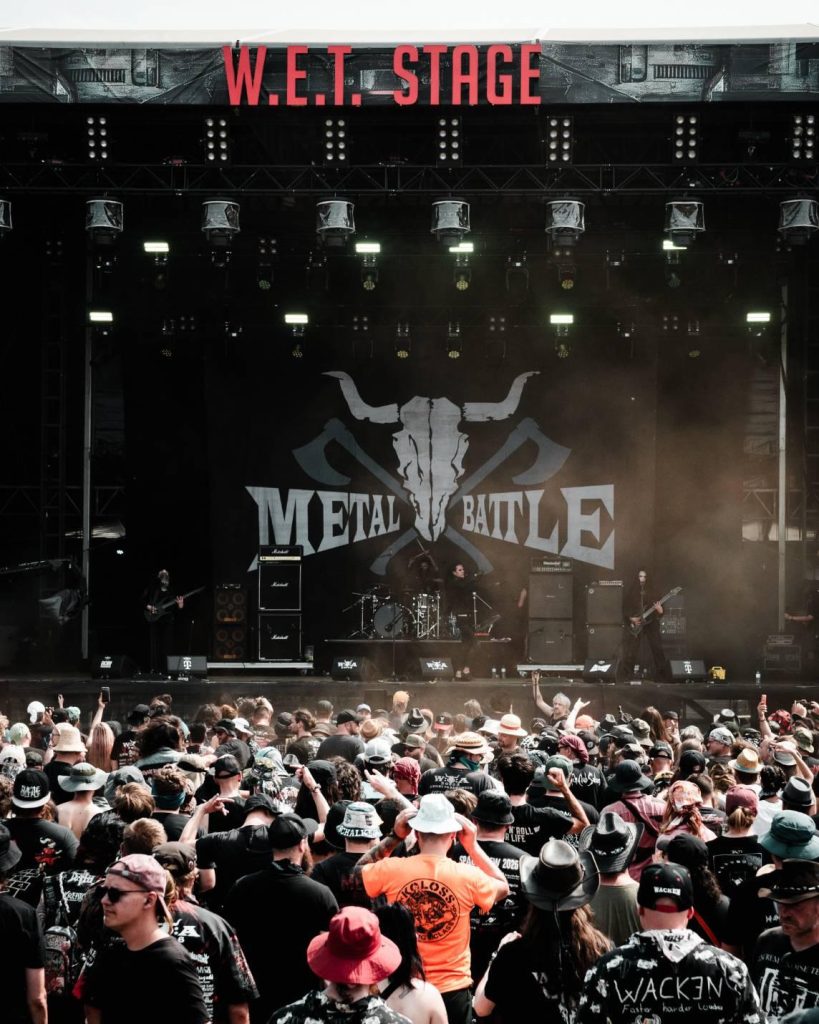
The day of the performance in the Metal Battle final on the W.E.T. Stage was marked by tension and excitement. Expectations for Japan were high, since in recent years two Japanese bands had won the Metal Battle final and taken 1st place: Sable Hills in 2022 and Phantom Excaliver in 2023.
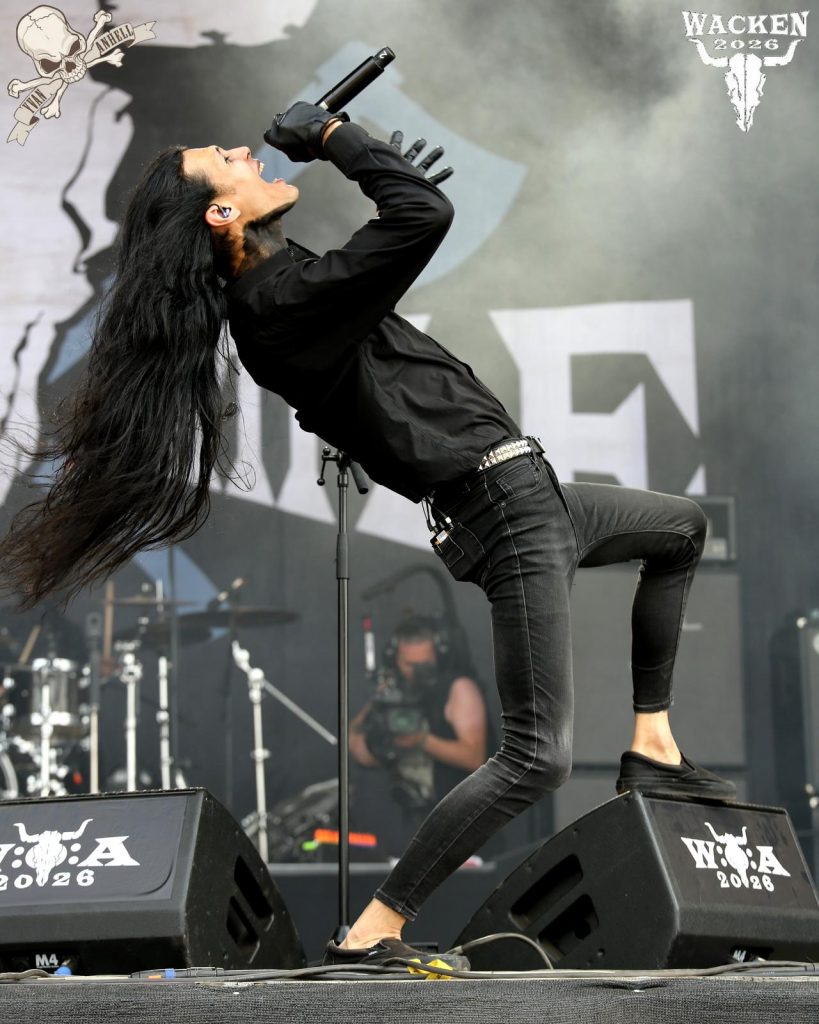
Photo by: Yvan Anhell
The artist shuttle picked up the band from the VIP campground, and about two hours before the performance they reached the backstage artist area. A container had been reserved for them with refreshments and space to change, apply makeup, and prepare. Their promoter Yutaro and other friends stopped by. Things were lively backstage. More and less well-known bands came and went, someone played guitar, drinks were restocked, and there was brisk activity at reception. Everyone was nervous, and then there was a moment when Willian completely changed. He had his makeup on and was barely approachable from then on.
The artist shuttle picked the band up on time for the soundcheck, and uncertainty before the performance was high: How big would the drum kit be? Who was responsible for the stage? There were hardly any clear answers. "We didn't really know what to expect. Nobody really had a point of contact for the stage." Still, the band blamed no one – maybe that's simply what happens when a band without a big name stands on such a big stage for the first time. Their conclusion: "You should always have a technician on the team who really understands the stage technology and the language – no matter the circumstances.“
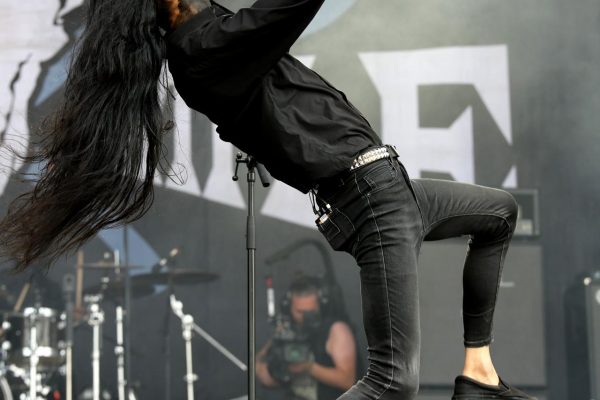
Fascinated, I stood in the front row in front of the W.E.T. Stage and barely recognized the band. Where had the friendly young men gone, the ones who'd been happy about hot coffee that morning? Given by the Flames conjured up an energy on stage that left me in awe. Willian especially, with his voice switching between clear and growling, his dark eyes and long hair, had incredible stage presence and flirted with the camera like a pro.
The next morning I had the chance to clarify two things with Willian. Why had he suddenly seemed so different once he had his makeup on, and where does the band's incredible stage presence come from? Willian explained, quoting Lemmy Kilmister, why he disappears into his role as if into a tunnel once he's made up: "If you're going to be a rock star, go be one. People don't want to see the guy next door on stage; they want to see a being from another planet." He'd truly pulled that off, and it left me completely fascinated.
My Metal Battle bands from the Middle East, who came to Wacken with me, were always completely overwhelmed by Wacken. Stages as big as Wacken's are rare in the Middle East and barely within reach for small bands. Not so for GBTF. Willian showed me footage from his band's shows in Tokyo. A large indoor stage with immersive projections filling the entire hall. That's when it first became clear to me that Wacken isn't the ultimate experience for every Metal Battle band, but that different countries arrive with very different frames of reference.
In the end, Given by the Flames placed third in the worldwide final. I was happy for the band, but GBTF themselves would have loved to see themselves as winners. Yet when asked what they'd take away most from Wacken, the band's answer came surprisingly easily: not the trophy, but new friendships. And what was missing? More time on stage to present themselves even better – and merchandise, which sold out faster than expected. I'm sure Given by the Flames will make their way. And when they headline Wacken and other festivals one day, I'll watch proudly and say: look, years ago I sat with them at Wacken on the campground, and we tried bananas with Nutella.
Yutaro, the Japanese promoter, represents politeness and modesty to me. So I was all the more astonished when I saw him dancing to Eric's performance at the Warm-Up Barbecue!
Eric – The Man Who Gets Metalheads Dancing
I knew Eric Hutchence mainly as a fellow promoter. For a few years now, though, he's also been performing as a DJ within the Metal Battle community. This year I saw him as a DJ live for the first time myself, as he fired up the metalheads on the truck stage.
In fact, Eric has been on the road as a metal DJ for around 15 years now. It all started rather casually – with sets between live bands at local shows, while the audience waited for the next act. Later, the DJ side of things took a back seat, because he was busy organizing shows and his own open-air festivals. It was only during Covid, with a lot of forced time at home, that he started again – at first just for himself, for the fun of making his own remixes. When organizers of a festival remembered his old sets and invited him to Istanbul, it became clear: this is what he wanted to do again. From then on, it almost ran by itself – one festival recommended him to the next.
He doesn't actually like the term "DJ" for himself: "I'm not a DJ in the classic sense – more of a metal crossover act." He doesn't play original songs, only his own remixes, built to get a metal audience dancing. A mix of metal and electronic music, at times with drum-and-bass elements. His main instrument is a launchpad controller, which he occasionally straps on like a guitar; plus a microphone to interact with the crowd. No play button, but a live performance. Unlike a band with a fixed setlist, he reacts to the audience in real time: "That's one of the most important parts of my work – staying flexible, sensing what this crowd needs right now, to adjust the set in the moment.“
His visibility is noticeably growing, he said – step by step. In the past he was booked more as a filler act between bands; now he sometimes gets his own slot at festivals, with a proper stage, stage crew, and backstage access. As a role model he named a French DJ who has since developed into a full band project of his own – a possible model for Eric's own future. He's currently also working on a joint project with a fellow DJ friend; a shared performance is planned for October 2nd in Sofia.
His biggest lesson of recent years: clear communication with organizers beforehand, to avoid disappointment. His worst experience came at a small festival in Poland, where barely more than ten people were left after the last live band when he took the stage – he played anyway. "It was strange and a little sad at the same time.“
The Metal Battle promoters know Eric as a DJ above all from the legendary Warm-Up-Party at the World Metal Camp.
International Metalheads Meet at Kasper's World Metal Camp
I'd always actually assumed the World Metal Camp had been created for the Metal Battle promoters and their bands, but Kasper Molin had to correct me on that. I came to know Kasper in 2014 when he was still responsible for the Wacken Metal Battle Denmark and owner of his former company LiveScenen in Denmark. The last couple of years beside other businesses he took over the responsibility for the World Metal Camp in Wacken.
Every year I was curious about the camp – and this year also about Kasper’s new motorbike (which, by the way, I still haven't actually seen). There's something appealing about camping among international fans. But ceramic toilets and a VIP shuttle always won me over to staying in VIP camping instead. But curious as I am, I took a look into the camp every year, and this year it was special. Especially far from VIP camping, and especially beautifully laid out. With a large terrace, an area with hammocks, and a big tent for the annual Warm-Up-Party – on the Tuesday before Wacken really kicks off. The grillmaster is Kasper, and of course Eric is on the decks.
This year, I met Kasper mostly away from the stage – hanging out in the infield, between sets. But the actual conversation about his World Metal Camp we had later, over a video call, once the dust of Wacken had already settled. What he told me opened up a perspective I wouldn't have seen on site.
The World Metal Camp didn't start as an official Wacken project, but as a private neighborhood of two travel companies: Kasper's own company and a Swedish travel firm camped side by side for years, until it officially became the "Nordic Camp" – initially around 17 to 18 people from Denmark, Sweden, Norway, the Faroe Islands, and Iceland. Only once the concept proved itself was Kasper asked to open it up to all international travel partners. That's how a private tent neighborhood officially became the World Metal Camp.
The early days were laborious: for a long time, there was no fixed, reserved area on the festival grounds – it had to be renegotiated every year. Today, guests travel in from places including South America, knowing in advance that they have a reserved spot and will meet familiar faces. Anyone arriving alone is reassured: "I always tell people it's no problem to come alone – you'll always find someone to sit with here. And that's held true so far." At the same time, he finds it humanly understandable that many people first seek closeness with people from their own country before opening up further.
One idea that has never really worked out so far: integrating the Metal Battle bands directly into the World Metal Camp, so they can connect with the international fanbase. In practice, this has so far failed because of the distance – the bands camp in the VIP area, too far away to, say, spontaneously drop by with instruments. Kasper still can't explain why other established camps are located closer to the VIP area than the World Metal Camp – probably simply a matter of space, something he has no influence over himself.
This year, by his own account, the location was unusually good: their own coffee stand from Wednesday on, power to charge phones – "almost luxurious" compared to the two previous years. Asked whether the international mixing actually works, he answered honestly: most guests initially stick to their country or travel-partner groups, but everyone meets up at the shared program highlights – such as the aforementioned, by now legendary Warm-Up-Party. This tradition began around 20 years ago as a one-off, small barbecue evening and has grown steadily ever since – one year they even ran out of food. Kasper's favorite memory of it: an evening with good weather, good mood, Eric as DJ later in the evening, and a travel partner who came up to him excitedly and said that this was exactly "the Wacken feeling" – all worries from home forgotten for a moment, one big shared party.
Anyone who hasn't booked a spot through a travel partner is still welcome from Wednesday on, if there's capacity left – the camp isn't a closed event. According to him, the festival itself is also increasingly investing in the camp's infrastructure, for instance with flooring and a PA system.
All of this is now exactly one month ago – what remains?
On social media, terms like festival blues, Wacken blues are making the rounds. A hole you fall into in everyday life once you're back from festivals like Wacken. And indeed, everyday life catches up with you faster than expected. I wonder whether Given by the Flames were actually able to sustain their connections and are still in touch with them? Japan is far.
On Instagram they have fantastic photos from the Metal Battle, interviews as third-place finishers in the final, and congratulations from the official Metal Battle page. Willian tells me that after their return, they played two concerts in Tokyo, one of them as headliners. On Instagram they're promoting that Given by the Flames brought the fire back to Tokyo, and it shows a video snippet from their gig. The Japanese promoter Yutaro confirms this and adds that the concerts were a success for the band. On top of that, the band has an upcoming interview lined up with a well-known metal magazine, Young Guitar. Speaking for himself, he says he has the feeling that the Metal Battle is gaining significance in Japan. He bases that on the fact that, since his return, people have been asking him about it more. Yutaro attributes this, among other things, to the interviews that were recorded and streamed with the promoters right before their band's performance.
Also Eric wrote back to me. Right after Wacken, he went on to Amsterdam for a club gig, then to the Alcatraz Festival in Belgium for the first time: "Huge and really cool." The highlight for him: meeting several artists, including Evan Seinfeld of Biohazard. The two agreed to collaborate, which is currently in the works. Barely back home, Eric already played the next big festival by the sea, together with Dead By April and The 69 Eyes.
From Kasper, what I mostly see on social media are his motorcycle trips and his performance with his own band, Maiden Aalborg.
Everyday life has caught up with me too. And like every year, there are encounters and projects that stay, like writing for The Metalist, and others that were fleeting or only exist within Wacken. It feels strange to me, no longer belonging to the promoters and experiencing Wacken differently. That opens up new opportunities and projects for me, but there's also some wistfulness in it. What comforts me, though, is that I can continue to cover the Metal Battle and the festival as a journalist – and so I'm looking forward to a new chapter around Wacken.